The Slack Power Dynamic: Why Your “Instant Reply” Is Sabotaging Your Authority
Sarah is a corporate professional who works for a high visibility team under a fast paced executive.
Determined to prove her value and reliability, Sarah has fallen into a common trap. Every time her boss pings her on Slack, she drops everything to reply within seconds. She keeps her status on Slack “active” from early morning until late at night to show her boss that she is always available .
She did this thinking that her boss will Consider her a great team Member they can trust. she was hopeful that her sincerity will be rewarded with a promotion. But during the last promotion cycle, Sarah was passed over. The feedback? “Sarah is an incredibly reliable executor, but we need someone who can operate more strategically.”
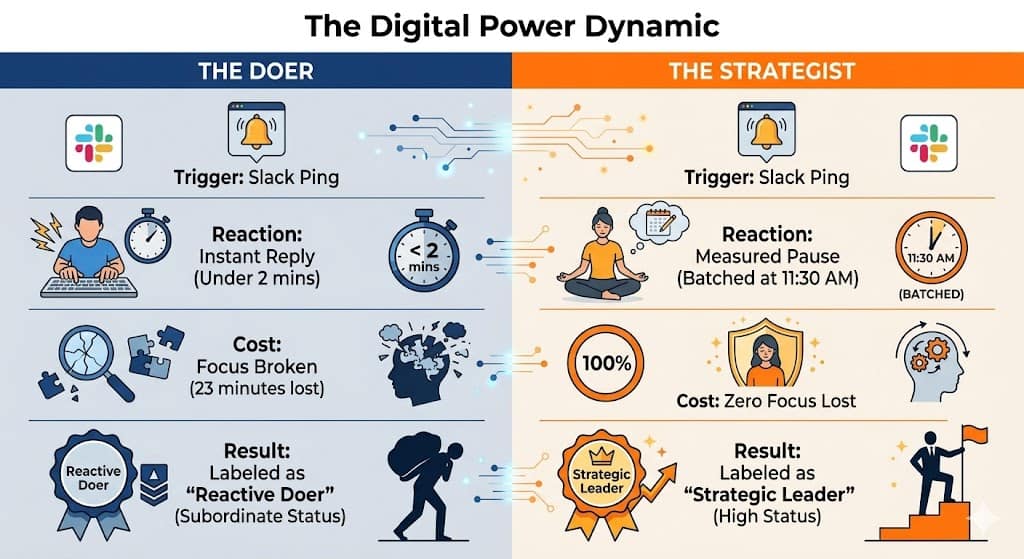
Sarah was furious. She was working harder and faster than anyone else. But what she did not realize that her lightning fast replies weren’t proving her productivity. They were actually doing the opposite – signaling her subordination. While she stressed over immediate pings, her competitors for promotion were using a behavioral technique called “intentional silence” to establish dominance.
I have been a Senior HR executive responsible for creating company frameworks for making promotional Decisions. What lot of people do not Realize is that promotions in companies do not only depend on hard work. It is as much about creating the right impression about your potential than anything else.
in this article, I will be sharing the digital body language of the modern workplace to show how such a Seemingly trivial thing like your Slack response time can create a perception – not always what you intend it to be. I will then provide you 4 behavioral hacks that you can start using right away for your benefit.
The Myth of Instant Connectivity
We live in a work culture that treats being “always on” as a badge of honor. But here’s what most people miss: the leaders at the top are often doing the exact opposite.
They’re slow to reply — and it’s completely intentional.
Your Response Time Is Sending a Message (Whether You Like It or Not)
In most companies, time works as an unofficial status symbol. The more valuable your time is perceived to be, the more acceptable it becomes to make others wait for a response.
It is called the Latency-Status Correlation.
When you fall into the trap of replying to every ping the second it arrives — what I call “Immediate Ping Syndrome “— you accidentally set a dangerous expectation. You basically tell everyone around you that whatever you are working on is easy to drop.
And that invitation brings more interruptions.
Data consistently shows that the fastest responders are often the reliable “doers” who get overloaded with work, while the people who protect their time are viewed as the “strategists” who get promoted.
4 Practical Hacks to Change How You’re Perceived at Work
Changing your reputation isn’t about doing less. It’s about behaviorally reprogramming what others expect from you.
Hack 1: Make Your Time Feel Scarce
The urge to reply instantly usually comes from wanting to seem dependable. That instinct is good — but the execution is working against you.
In business, scarce resources are considered valuable resources. Also per Behavioral science, the more scarcity you generate, more important something seems to be. So when you wait a little to respond to non-urgent messages, you quietly signal that your calendar is packed with high priority work.
Over time, you stop being seen as the person who’s always available and start being seen as the person who’s always focused.
Hack 2: Build Digital Friction Into Your Day
Most of us check Slack or email out of pure habit. A red badge pops up or we get a notification, and we click before we’ve even thought about it.
You can’t fix this habit using willpower — you need to apply friction.
Make the habit harder to do automatically:
- Turn off all desktop notifications
- Mute group chats that rarely need your attention
- Move the app off your phone’s home screen
When checking a message requires three clicks instead of one, you stop doing it on autopilot.
Hack 3: Use a Physical Pattern Interrupt
That jolt of anxiety you feel when a message comes in? It’s a physical reflex, not a rational decision.
Break the loop before you act on it.
The next time you feel the urge to drop everything and type back immediately — stand up. Take a breath. Walk to grab some water. Stretch for 20 seconds.
This short reset gives your brain just enough space to ask the real question: Is this actually urgent, or does it just feel that way?
Hack 4: Escape the Double Bind with Implementation Intentions
Here’s the uncomfortable reality most professionals face:
- Reply instantly → you look like an order-taker with no priorities of your own
- Go silent → your boss starts to worry you’re checked out
This is a classic double bind — and most people don’t realize they’re stuck in it.
The way out is something psychologists call an “Implementation Intention“: a clear, pre-announced plan for when and how you handle messages. A delayed response stops looking like laziness and starts looking like discipline.
This matters more than you might think. Research shows that every time you pause your work to answer a quick message, it takes around 23 minutes to fully get back into the zone. That’s not a small cost — it’s the difference between good work and great work.
Make your availability visible, so no one has to guess.
For your Slack status:
“Busy until 11:30 AM. Processing messages then. Call my cell for true emergencies.”
For a delayed reply:
“Hi [Name] — I saw this come in. I’m heads-down for the next two hours finishing the Q3 analysis before your afternoon meeting. I’ll have a full answer for you by 2:00 PM.”
The Bottom Line
Not responding immediately isn’t about being less responsive. It’s about being more intentional — and letting that intention speak for you.
Protect your focus, and you’ll do better work. Do better work, and leadership stops seeing you as someone to delegate to and starts seeing you as someone to think alongside.
The slowest reply in the room is often coming from the person everyone most wants to hear from.
Why Trust My Advice?
As a senior HR executive at global organizations and a behavioral coach, I’ve directed talent strategies for thousands of employees across technology, finance, CPG, and Manufacturing sectors. I’ve participated in Promotion and Performance Calibration sessions, observed how decisions are made, and guided hundreds of professionals to not just survive but thrive in challenging markets. My strategies aren’t theoretical—they’re battle-tested, creative, based on behavioral science, and designed to provide you with a competitive edge.
Click here for my LinkedIn Profile.
Whether securing a promotion or avoiding a layoff, I offer personalized coaching based on a combination of behavioral insights and real-world experience not available elsewhere.
For other insightful articles on Career Growth and Job Search, please read my blog.
For short videos of easy to apply Behavioral techniques in your Career and Workplace situations – Please subscribe to my YouTube Channel
If you want to learn how to build and apply behavioral skills like Self-confidence, mastering these steps, check out my behavioral coaching programs at www.changeforresults.com.
Let us build your dream career together.
#howtogetpromoted #SlackResponseTime