How to Build Unshakable Confidence at Work: 5 Micro-Habits for Career Growth
If your goal is to accelerate your career and land that next promotion, being good at your job is no longer enough.
Leaders don’t just execute. They look like they belong in the room — before they’ve said a word. That quality has a name: executive presence. It’s the unspoken criteria nobody puts in a job description, but everyone uses to decide who moves up.
The good news? It’s not a personality trait you’re born with. It’s a set of daily habits — micro-habits, specifically — that you can build deliberately, starting this week.
But first, let’s kill one myth. “Fake it till you make it” is dead advice and does not work in the real world. We as senior leaders have seen every version of people faking confidence. We can spot it fast. What actually works is understanding why certain behaviors that you exhibit, signal authority to the people around you — and then making those behaviors automatic.
These are not the feel-good tips that you get from the online articles that primarily depend on providing management advice. While good, they do not always work in every situation and are not sustainable because they are not behaviors that you are able to generate automatically. To handle that, you need to build habits. These five meetings habits I am sharing below, build unshakable self-confidence from the inside out. They are grounded in behavioral science and are sharpened by my 35 years of corporate experience in global companies.
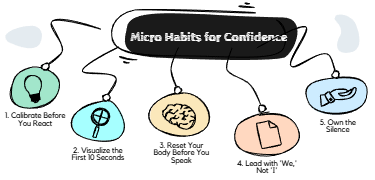
1. Stop Reading Into Silence — Build a Calibration Habit Instead
Why it trips you up: Your brain is wired to scan for threat. So when your manager sends a one-word reply right before your big presentation, your inner critic immediately fires: Did I mess something up?
That anxiety spiral — what behavioral scientists call negativity bias (our tendency to assign worst-case meaning to neutral signals) — kills your focus before the meeting even starts.
Instead of trying to talk to yourself like you love yourself with generic affirmations, you need something more concrete: data.
What to do instead: Before any important meeting, take two minutes to look at how that person has been communicating with everyone lately — not just you. Check their recent messages to the broader team. Has their tone shifted across the board? That’s situational, not personal.
This is what behavioral science calls sensory acuity — the ability to read your environment accurately instead of through the distorted lens of anxiety. It’s also how you keep small promises to your own nervous system: you prove to yourself, with evidence, that you are safe and grounded in reality. That’s what real confidence is built on.
Think of it as the antidote to the 5 second rule — instead of forcing yourself to act before doubt sets in, you remove the doubt entirely.
Real example: I once worked with a Marketing Director who was convinced she was being quietly pushed out. Her VP’s emails had gone cold and clipped. Before a major strategy session, I asked her to look at his messages to the whole team for the past two weeks. Same pattern everywhere — terse, declarative, no warmth. Turned out the company was mid-merger. She walked into that pitch focused on her work, not her job security.
Try this mental shift:
- Instead of: “He’s being short with me — I must have dropped the ball on the Q3 report.”
- Tell yourself: “I’ve checked the baseline. His behavior right now is situational, not a performance signal.”
- In the room: “Based on what we’ve looked at, this approach gives us the strongest position going into Q4.”
2. Visualize Winning Before Every Big Meeting
Why it trips you up: Generic positive thinking fails because it has no plan attached to it. Walking into a room hoping you won’t freeze actually increases cortisol (your stress hormone) because your brain is focused on the threat, not the outcome. The famous 5 second rule — counting down to force action — can interrupt hesitation. But it doesn’t wire in a success pattern. Visualization does.
What to do instead: This is one of the most research supported ways to boost confidence before a meeting and is called “Victory visualization before meeting”. In the 60 seconds before you walk in, vividly rehearse only the first 10 seconds — walking in calm, making eye contact, starting your opening sentence with a steady voice.
This is not magic. It’s the same technique successful athletes use before competition. The goal is to make your brain feel like it’s already been there.
This works because your brain processes a vividly imagined experience almost the same way it processes a real one. Rehearse those 10 seconds enough times, and your nervous system will treat the moment as familiar when it actually arrives.
Real example: A junior consultant I coached was terrified of presenting to senior executives. We stripped her prep down to one thing: a 60-second mental run-through of walking in, making eye contact with the executive, and opening with a calm, clear sentence. By the time she walked into the actual room, her brain had already encoded it as something she’d done before. She opened without a hesitation in her voice.
Try this mental shift:
- Instead of: “I really hope I don’t forget my opening lines.”
- Tell yourself: “I’ve already run this. I know how it starts and I know how it lands.”
- In the room: “I’ve put together a focused overview so we can make the most of our time today.”
3. Do a Body Language Reset Before You Walk In
Why it trips you up: If you feel talked over in meetings, the problem often starts before you open your mouth. Hunched shoulders, hiding your hands under the table, leaning back in your chair — these are submissive posture signals your body is sending that the people around you read unconsciously. People interrupt those who look like they expect to be interrupted.
This is the core insight behind embodied cognition — the science showing that your body doesn’t just reflect how you feel, it actively shapes how you feel. The right posture doesn’t just change how others see you. It changes your own neurochemistry, shifting your hormonal balance in ways that genuinely affect confidence in meetings.
What to do instead: Your body language shapes how you feel — and how others respond to you. Sit forward slightly. Keep your hands visible on the table. If you can, arrive early and choose a seat where you’re visible and central, not tucked into a corner. Use the first moment of a meeting — reaching for a glass of water, adjusting your laptop — to stand briefly and deliver your opening while upright. It works because standing gives your voice more authority and resets the room’s sense of who’s leading
Real example: I worked with a sharp manager who kept getting cut off by her peers. The issue wasn’t her ideas — it was how she was sitting. She’d take the lowest chair, lean back, and wait to be invited in. We made one change: she started arriving early, taking a central seat, and using the “stand and open” move. The interruptions stopped within a week.
Try this mental shift:
- Instead of: “Is it okay if I jump in?” (You’ve already signaled low status.)
- Do: Plant your feet, sit forward, take a breath — then speak with certainty.
- In the room: “Let’s get started. We’ve got three outcomes to hit today — let me walk us through them.”
4. Swap “I” for “We” — It’s a Leadership Signal, Not a Grammar Tip
Why it trips you up: Newer professionals tend to overuse “I” — I think, I decided, my plan. It’s rarely arrogance. Usually it’s insecurity seeking individual validation. But it keeps you in the position of someone asking for approval rather than someone setting direction.
Pay attention to how senior leaders frame things. They almost always say “we.” It’s not about erasing yourself — it’s about positioning your ideas as shared direction rather than personal opinion. When you say “we,” you’re not asking people to agree with you. You’re inviting them to join something already in motion.
A phrase like “As we know…” or “What this gives us…” does something subtle but powerful: it uses what influence researchers call isopraxism — the social pull toward agreement with what’s already being treated as consensus. You’re not seeking buy-in. You’re orchestrating it.
Real example: A newly promoted Tech Lead was struggling with his former peers. Every time he said “I decided we should do this,” they pushed back — not always on the idea, but on his right to decide. We replaced the “I decided” language with collective framing. “What we’ve landed on,” “the direction we’re taking.” The friction dropped almost immediately.
Try this mental shift:
- Instead of: “I think my plan for the rollout will work.”
- Say: “This rollout approach gives us the clearest path to our Q4 target.”
5. Learn to Speak Up in Meetings — Then Stop Talking
Why it trips you up: When a room goes quiet after you’ve spoken, the instinct is to fill the silence. To over-explain. To add “…does that make sense?” at the end of every point. It feels collaborative — but it reads as uncertainty. And uncertainty is contagious.
Behavioral scientists call this noise as anxiety displacement — we fill silence not because it helps the listener, but because it soothes our own discomfort. The irony: the more you over-explain, the less authority your words carry.
What to do instead: Use what I call the Strategic Silence Protocol — After you make your point, stop. Don’t trail off. Don’t add a disclaimer. Just pause — even for two or three seconds. Let the thought land. Hold your gaze steady and relaxed.
This is one of the most underused tools for building unshakable confidence at work – and is harder than it sounds. Most people fill silence because it feels awkward. But the person who controls the pause controls the room. Silence after a strong statement signals that you don’t need the room to validate what you just said.
Real example: I once watched a VP take control of an important meeting that had dissolved into cross-talk and chaos. He didn’t raise his voice. He stood up, said one clear sentence, and then sat back down and said nothing. He looked around the table and waited. Five seconds of silence. The room settled and looked to him. It was one of the most effective moments of leadership in my long corporate career.
Try this mental shift:
- Instead of: “…so does that make sense to everyone?” (trailing up, palms open)
- Do: State your point. Pause three full seconds. Hold eye contact. Stay still.
- Then: “I’ll stop there — I want to hear how this lands for each of your teams.”
The Bottom Line: Confidence Is a Practice, Not a Personality
Micro habits and confidence are more tightly linked than most people realize. The professionals who move up fastest aren’t always the most talented — they’re the ones who learned to make their competence visible, consistently, in the moments that count.
These five daily habits for confidence won’t rewire you overnight. But pick one. Use it deliberately in your next three meetings. You’ll feel the shift — and so will the room.
Unshakable confidence at work isn’t a gift. It’s a practice. And you’ve already started.
What’s the one meeting situation where you lose confidence the fastest? Drop it in the comments — I read every one.
You Don’t Have to Navigate This Alone
If you’re reading the signals and recognize these signs that tend to paralyze you before meetings, know that this can be changed.
As a behavioral coach and senior executive with 35 years of mentoring professionals for Fortune 500 companies, I have extensively worked with individuals who are exactly at this crossroad.
Whether you need help interpreting why and how you feel a certain way and want to reposition yourself for success, please feel free to reach out.
Visit www.careerresumecoach.com to learn more about 1:1 coaching engagements, or to book a confidential strategy session.
Who Am I?
As a senior HR executive at global organizations and a behavioral coach, I’ve directed talent strategies for thousands of employees across technology, finance, CPG, and Manufacturing sectors. I’ve participated in Promotion and Performance Calibration sessions, observed how decisions are made, and guided hundreds of professionals to not just survive but thrive in challenging markets. My strategies aren’t theoretical—they’re battle-tested, creative, based on behavioral science, and designed to provide you with a competitive edge.
Click here for my LinkedIn Profile.
For other insightful articles on Career Growth and Job Search, please read my blog.
For short videos of easy to apply Behavioral techniques in your Career and Workplace situations – Please subscribe to my YouTube Channel
If you want to learn how to build and apply behavioral skills like Self-confidence, mastering these steps, check out my behavioral coaching programs at www.changeforresults.com.
Let us build your dream career together.