
When a Coworker Acts Like Your Boss: How to Shut It Down — Professionally!
Studies consistently show that nearly 85% of employees face some form of workplace conflict – and colleagues overreaching their authority is one of the most underreported forms of it. Most people never address it. Here’s why that’s a costly mistake.
There is a coworker on almost every team who does this.
They are not your manager. They have no formal authority over you. But somehow, in the guise of dividing up work in the team to meet a goal, they have started assigning you work, questioning your decisions, and issuing deadlines – as if you are answerable to them.
And here is the part that is troubling: you have been putting up with it.
Not because you are weak. Because you are professional. Because you don’t want to create drama. Because you are a team player and your thinking is – “it’s just one task.”
In my career I have watched this dynamic play out hundreds of times. And let me tell you: what feels like politeness on your part is actually costing you more than you realize – quietly,, and in the places that matter most to your career.
The Unwritten Rule Nobody Warns You About
The workplace is not a family. It is a system of informal hierarchies – and in that system, people treat you according to the image you project, not the official title you carry.
So at work, authority is frequently seized, not granted.
When a peer assigns you tasks – even casually, even with a smile – they are running a quiet test. They are probing to see where your boundaries are. If you accept the work without pushback, you have answered their question. You have signaled that the dynamic is acceptable. And from that moment forward, the entire team – including your actual manager – begins forming an unconscious picture of who leads and who follows on this team.
This is not dramatic. This is behavioral science.
What researchers call social dominance signaling – the subtle, often nonverbal ways people establish rank – operates below the level of conscious awareness in most workplaces. Nobody announces, “I am now treating you as a subordinate.” It just starts to happen. And once it does, it is genuinely hard to reverse.
Why Smart Professionals Keep Saying Yes – When They Know They Shouldn’t
There is a specific pattern behind why capable, intelligent professionals keep accepting work from peers who have no right to assign it.
Your brain is doing a rapid cost-benefit calculation every time this happens – and it keeps deciding that saying yes is cheaper than the discomfort of saying no.
Behavioral researchers call this over-responsible sorting: the tendency to absorb other people’s problems because the tension of pushback feels harder to manage than the work itself.
But the calculation is wrong.
When a dominant coworker walks up to your desk, leans over you, or uses body language that physically towers above you, your nervous system reads it as a low-grade threat signal. Without your conscious awareness, you move into what psychologists call a comply response. The anxiety of the moment drives you toward the path of least resistance: you take the task.
This is not a personality issue. It is a very human, automatic reaction. But it has a career cost for you that compounds silently over time.
The Real Cost: It’s Not About the Task
Here is what most people miss about this dynamic.
The task itself – the spreadsheet, the report, the data pull – is not the real problem. The real problem is the story the room is telling about you while you are doing it.
Every time this happens, the senior leaders in your organization are forming an impression of who has informal authority and who defers to it. These mental models are built from observation – not from performance reviews. When your colleague consistently gives you direction, and you consistently accept it, leadership observes the behavior and draws conclusions.
Here is a case study from one of my previous companies that captures this precisely
Two mid-level marketing strategists – Sara and Jeff- shared the same job title and the same reporting line. Jeff had an aggressive, expansive personality. Sara was skilled, diligent, and deeply conflict-averse.
One afternoon, Jeff walked to Sara’s desk, dropped a data-entry project in front of her, and said: “Can you get this done by Friday?” Sara – ankles crossed under her chair, a classic body language signal of suppressed anxiety – said nothing and took the work.
This happened once. Then again. Then it became a pattern.
Within two months, their department head had unconsciously begun viewing Jeff as management material and Sara as a capable but junior contributor. Sara hadn’t changed jobs. She hadn’t underperformed. She had simply allowed a dynamic to establish itself – and the room had drawn its conclusions.
Sara eventually realized what was happening. The next time Jeff dropped a project on her desk, Sara did something different. She stood up. Not dramatically. Not aggressively. She simply stood – eliminating the height advantage. She held calm, steady eye contact. Then she delivered one clear, non-confrontational sentence. Jeff walked out holding his own paperwork.
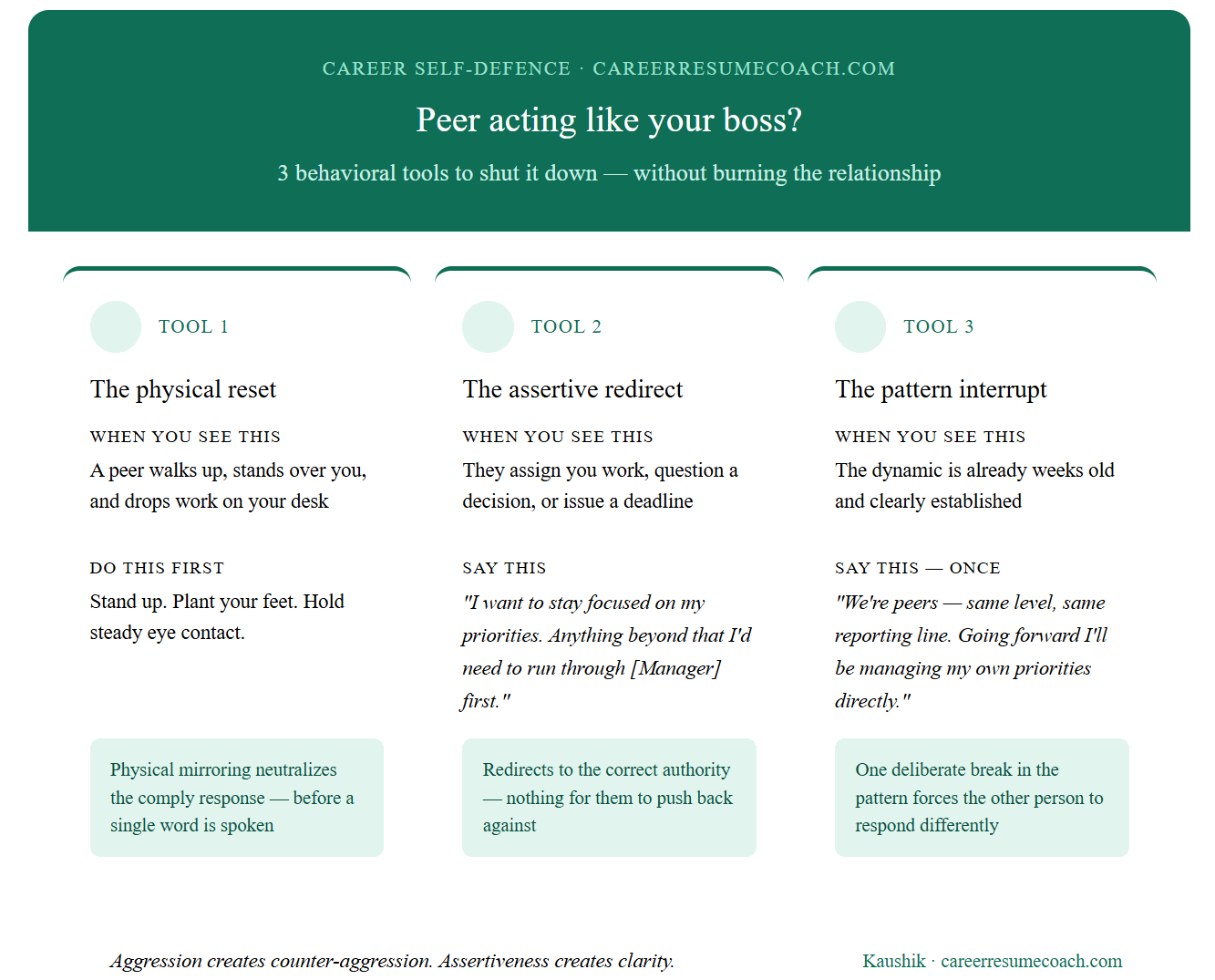
How To Deal With The Bossy Coworkers – Three Behavioral Tools
The goal is not to embarrass your coworker or escalate to HR every time this happens. The goal is to use assertiveness – not aggression – to permanently reset the dynamic. There is a critical difference between the two. Aggression creates counter-aggression and makes you look reactive. Assertiveness simply makes your position clear, respects the other person’s coworker status, and leaves no ambiguity about who is managing your work.
| Tool 1: The Physical Reset |
Dominant body language works by triggering a compliance response. The most immediate way to interrupt it has nothing to do with words – it is physical.
When a colleague approaches your desk with strong energy, do not stay seated. Stand up. Not to confront – to equalize. When you remain seated and they stand over you, your nervous system reads the situation as subordinate before a single word is exchanged. Standing immediately neutralizes that dynamic.
How to do it: Stand up. Plant your feet shoulder-width apart. Keep your posture open – no crossed arms. Hold steady, calm eye contact. This one move interrupts the subconscious power signal before anything is said.
Why it works: Researchers in behavioral science have consistently shown that physical mirroring – matching the other person’s postural level – creates an immediate psychological reset toward equality. The comply response cannot activate when you are standing at equal height with a calm, grounded posture.
| Tool 2: The Assertive Redirect |
Once you are physically equal, the words matter. The script below works because it is warm, professional, and completely clear. It does not attack the person. It does not create drama. And it makes it crystal clear that you report to one person – and that person is not them.
| Avoid saying this“Sure, I’ll get that done.” (Said with a smile to avoid tension – but at significant long-term cost.) | Say this instead: “I want to make sure I stay focused on my current priorities. Anything beyond that I’d need to run through our Boss to make sure we’re aligned on sequencing.” |
Why this script works: It is not a refusal – it is a redirect to the correct authority. It signals to your peer that you have work given to you by your manager, you respect and give priority to that, and any attempt to bypass it will be brought into the open. Most people stop immediately.
| Tool 3: The Pattern Interrupt – Used Once, Used Firmly |
If this dynamic has been going on for a while and is already established, you need one clear, explicit reset. This is not a confrontation. It is a professional conversation – initiated by you, in a neutral moment, when neither of you is in the middle of a task handoff.
| Avoid Continuing to accept work and hoping the dynamic corrects itself. (It won’t.) | Say this instead: “I’ve been thinking about how we divide up work on the team. I want us both to be clear that we’re peers – same level, same reporting line. Going forward, if there are coordination questions, I’m happy to work through those together with the Boss. But I’ll be managing my own workload and priorities directly.” |
Say it once. Calmly. Then hold the line every time after that. The behavioral science term is pattern interrupt – a deliberate break in an established behavioral sequence that forces the other person to respond differently because the old script no longer works.
The Bottom Line – How to Set Boundaries With Coworkers
If a peer is assigning you work, questioning your decisions, and issuing you deadlines – and you are accepting it – you are not being a team player. You are allowing someone else to quietly impact your career negatively.
That story is being read by everyone around you. It will eventually reach the people who decide promotions, high-visibility assignments, and who gets tapped for leadership.
The good news is that this is completely reversible. One clear, calm, professional reset – grounded in the right body language and the right words – is enough to change the dynamic permanently.
You do not need to be aggressive. You just need to be unambiguous.
A question worth sitting with: Think about the last time a peer assigned you work you didn’t push back on. What did the room conclude – and who is telling that story now?
Have you been in this situation – or watched it happen to someone else? Drop it in the comments. I read everyone.
You Don’t Have to Navigate This Alone
If you recognize this pattern in your own workplace — and you are not sure how to reset it without damaging important relationships — that is exactly the kind of situation I work through with clients every day.
As a behavioral coach and senior executive with 35 years of mentoring professionals across Fortune 500 companies, I have seen this dynamic in virtually every organization I have worked with. And I have helped hundreds of professionals reset it — professionally, permanently, and without burning a single bridge.
Visit www.careerresumecoach.com to learn more about 1:1 coaching engagements or to book a confidential strategy session.
Who Am I?
As a senior HR executive at global organizations and a behavioral coach, I have directed talent strategies for thousands of employees across technology, finance, CPG, and manufacturing sectors. I have participated in promotion and performance calibration sessions, observed how decisions get made at the top, and guided hundreds of professionals to not just survive but thrive in challenging markets. My strategies are not theoretical — they are battle-tested, grounded in behavioral science, and designed to give you a competitive edge.
Click here for my LinkedIn Profile.
For other articles on career growth and workplace dynamics, read my blog.
For short, practical videos on behavioral techniques you can apply immediately — subscribe to my YouTube Channel.
For behavioral coaching programs on self-confidence and professional presence — visit [www.changeforresults.com.]
Let us build your dream career together.