The Strategic Silence Hack: Why a 3-Second Pause Makes You the Most Influential Voice in the Room
Let me tell you about David. David was a Director of Marketing in one of the companies I worked for. He prepared for hours before the important executive meeting. He waited for the perfect moment and then presented his brilliant idea based on solid facts and data that he had collected.
Crickets. The conversation in the meeting however rolled right over him. Nobody reacted or appreciated his idea. It was as if people did not hear or notice it at all. Five minutes later, an aggressive colleague repeated David’s exact point. The room reacted with excitement. The colleague got the credit.
David was disappointed. His immediate reaction was – next time I need to talk more, talk louder, talk faster.
But he is wrong. If he does that, he will just be fighting for airtime instead of being able to control the room and get people to agree to his idea.
I spent 35 years as a senior HR executive deciding who got the promotion and who stayed stuck in Their roles. We didn’t promote the loudest people. We promoted the people who added real value in meetings vs. just Blabbering Continuously.
This is because Influence in the corporate meeting room isn’t about who talks the most. It’s about knowing when not to speak.
Here’s exactly how a 3-second pause can stop you getting overlooked and start moving your career forward.
Why do I speak up in meetings but get ignored?
The Problem: You jump into conversations fast to prove you belong in the room.
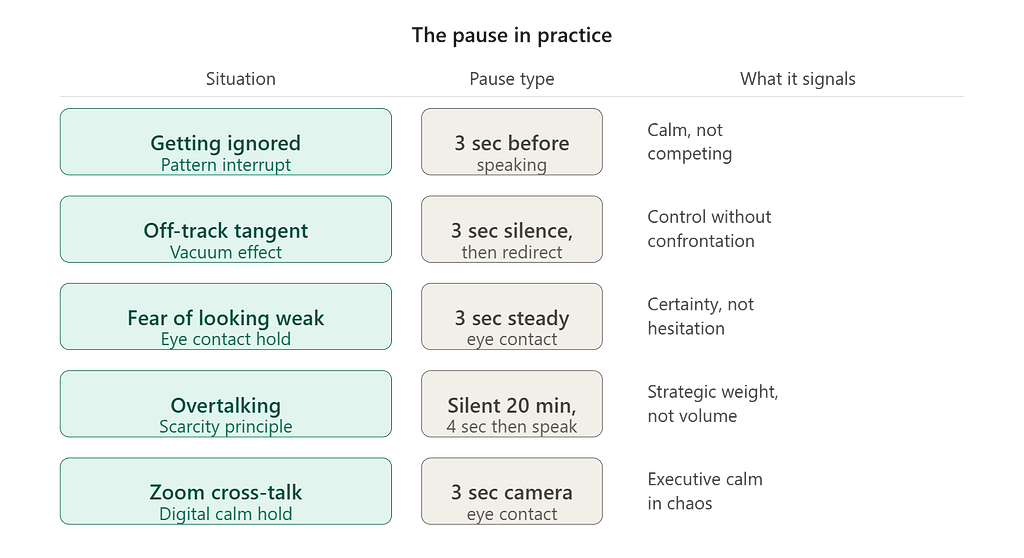
The fix: The Pattern Interrupt.
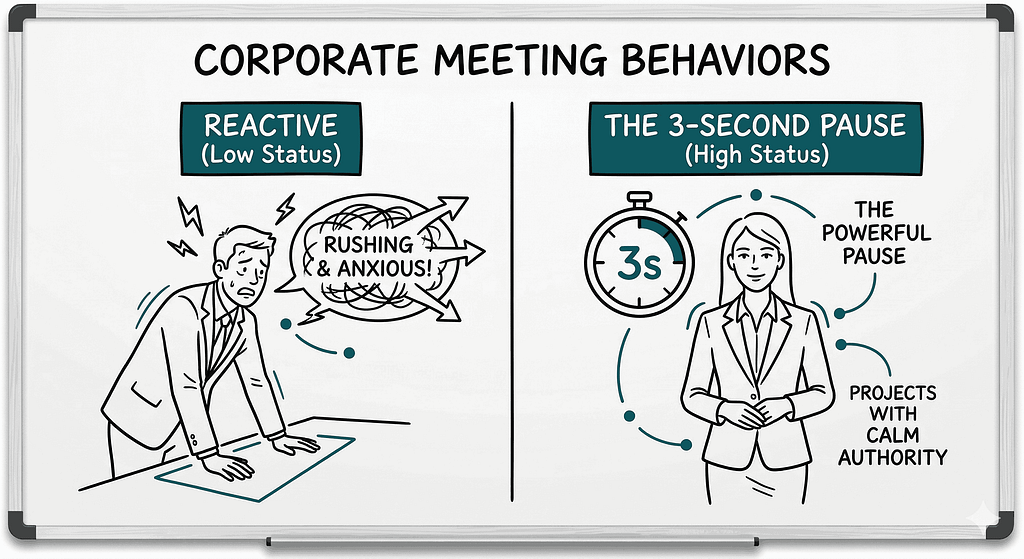
When you rush to speak, your colleagues subconsciously feel you’re competing with them for space. Research published in the Journal of Applied Psychology confirms that jumping in too quickly signals anxiety — and low status.
Don’t do this: Jump in to fill the first breath of silence with “I have an idea about that.”
Do this instead: Plant your feet flat on the floor. Take one visible breath. Count to three in your head. Then speak.
How do I steer the agenda without sounding pushy?
The Problem: A colleague takes the meeting off track. You need to pull the group back to the meeting’s agenda without triggering a conflict.
The fix: The Vacuum Effect.
A 2025 behavioral study by Alex B. Van Zant shows that people are deeply uncomfortable with silence. A brief, unfilled pause disrupts their thought pattern and forces them to lean in. They’ll either agree — or reveal what they actually object to. Either way, you gain control of the floor.
Don’t say: “We’re getting off track. Let’s go back to the main point.”
Say this instead: [Wait 3 full seconds of silence.] “Building on that — the core issue we need to resolve today is…”
Will pausing make me look hesitant?
The problem: You worry that pausing signals you’ve lost your train of thought.
The fix: Hold your ground physically.
Hesitance is physical, not verbal. Looking away, darting your eyes, dropping your shoulders — these signal uncertainty before you’ve said a word. As body language researcher Tonya Reiman notes, steady eye contact during silence signals internal certainty. It forces the room to focus on you, not despite the pause, but because of it.
Don’t say: “Um, well, I think we should maybe consider the budget.”
Say this instead: [Drop your shoulders. Hold eye contact.] “The budget is our primary constraint.” [Pause 3 seconds. Don’t break eye contact.] “Here’s how we bypass it.”
How do I show leadership without dominating the meeting?
The problem: You comment on every agenda item to signal engagement. Instead, people tune you out.
The fix: The Scarcity Principle.
We value what’s rare. If you speak constantly, your words lose weight. A 2025 Wharton paper on strategic silence found that employees who hold back until the right moment are rated significantly more influential by senior leadership.
Don’t do this: Offer an opinion on the first three minor items just to be heard.
Do this instead: [Stay silent for the first 20 minutes. Listen. When the most critical item hits, wait 4 seconds.] “I’ve listened to the approaches on the table. The core issue connects all of them. Here’s the strategy we need.”
How do I use this on Zoom?
The problem: Digital meetings are full of lag and cross-talk. You feel invisible behind your screen.
The fix: Digital Calm.
Everyone else is stressed by the chaos. When you don’t rush to fill the silence, you become the still point in the room. That’s executive presence — and it’s visible even through a screen.
Don’t say: “Sorry, go ahead. No, you go — I was just going to say…”
Say this instead: [Let them finish. Unmute. Look directly into the camera lens. Wait exactly 3 seconds.] “Here’s the direction we’re taking.”
Where this pays off beyond the meeting room
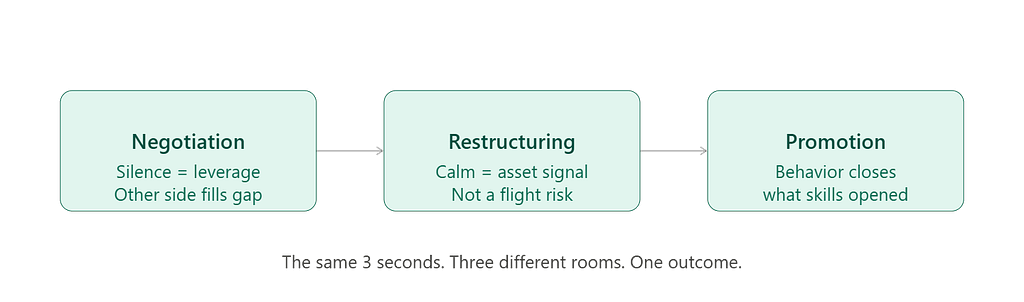
These aren’t just meeting tactics. The same 3-second behavior changes the outcome in three high-stakes situations.
Salary negotiations. The person who speaks first usually concedes first. Silence forces the other side to negotiate against themselves.
Surviving restructuring. Layoff decisions aren’t purely metric-driven. Leaders who project calm authority are read as strategic assets. Anxiety signals risk.
Getting promoted. Skills get you to this level. Behavior gets you to the next one. When you hold the room, executives picture you in a bigger chair.
What to do next
You don’t need to change your personality. You need a behavior shift.
If you’re a mid-career professional who’s tired of being passed over, working harder won’t solve it. The gap between where you are and where you want to be isn’t a skills gap. It’s a behavioral one.
Three seconds. That’s the gap.
Reach out and let’s build a strategy around it.
Why Trust My Advice?
As a senior HR executive at global organizations and a behavioral coach, I’ve directed talent strategies for thousands of employees across technology, finance, CPG, and Manufacturing sectors. I’ve participated in Promotion and Performance Calibration sessions, observed how decisions are made, and guided hundreds of professionals to not just survive but thrive in challenging markets. My strategies aren’t theoretical—they’re battle-tested, creative, based on behavioral science, and designed to provide you with a competitive edge.
Click here for my LinkedIn Profile.
Whether securing a promotion or avoiding a layoff, I offer personalized coaching based on a combination of behavioral insights and real-world experience not available elsewhere.
For other insightful articles on Career Growth and Job Search, please read my blog.
For short videos of easy to apply Behavioral techniques in your Career and Workplace situations – Please subscribe to my YouTube Channel
If you want to learn how to build and apply behavioral skills like Self-confidence, mastering these steps, check out my behavioral coaching programs at www.changeforresults.com.
Let us build your dream career together.
#howtogetpromoted #StrategicSilence #careergrowth #verbalcues #workplaceissues #behavioraltechniques