
In my Career Coaching practice, lot of professionals express concern about saying NO to their bosses, even when they are overwhelmed. This is mostly because of their fear of losing out or that of creating an impression of being lazy or unproductive.
I tell them that there are clever strategic ways to do that without feeling burned out.
If you are reading this, you probably know the feeling. You are good at your job. You work hard. But you are absolutely exhausted.
You look around and wonder why everyone else seems fine, while you are checking emails at midnight or snapping at your family over small things.
Here is the truth: You are not weak. The modern workplace is designed to keep you “always on.” This stress is hitting everyone hard, especially younger professionals. But when you feel like you are drowning, the usual advice is useless.
People tell you to “just set boundaries.” But they don’t tell you how.
If you just say “No,” you worry you will look lazy or difficult. But if you say “Yes,” you burn out.
Imagine if you had a special way to say no that actually made your boss trust you more.
There is a method for this. It is called the Collaborative Refusal Method. It is a simple behavioral framework that helps you protect your time without starting a fight.
Why “Just Saying No” Fails
When you tell a boss “I can’t do that,” their brain hears “I won’t help you.” They might think you are being difficult.
The Collaborative Refusal Method is different. It makes the other person feel heard and respected. It turns a “No” into a problem we solve together.
Here are the 5 phases to saying no like a pro.
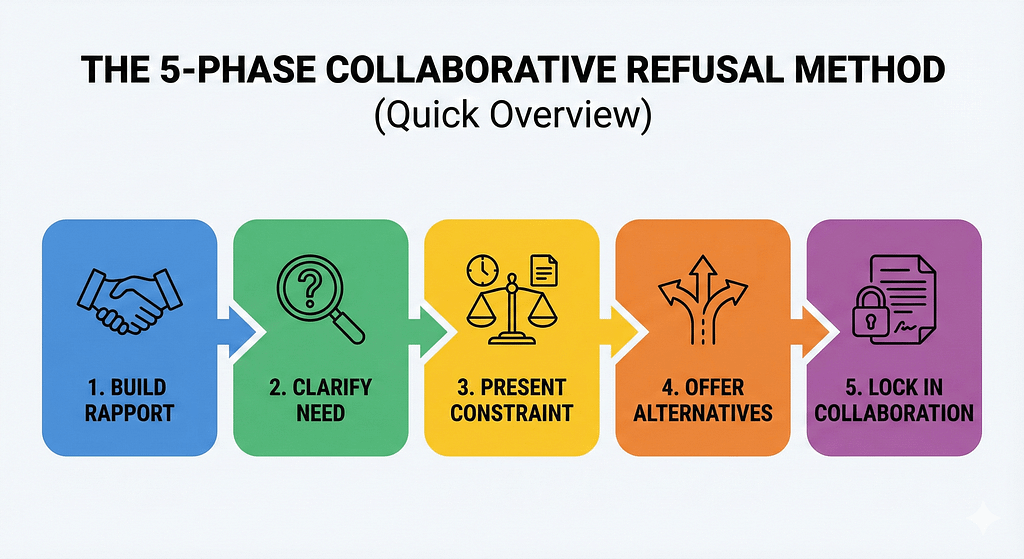
If you are short of time or would like the short visual version please click here to watch the YouTube Video.
Phase 1: Start with Understanding (Build Trust)
Before you say no, you have to show them you are listening. If you jump straight to “I can’t,” they get defensive.
What to do: Acknowledge that their request is important.
The Script:
- “I can see why getting this report done is critical for Monday.”
- “I appreciate you trusting me with this urgent project.”
Why it works: When people feel heard, they relax. They stop fighting you and start listening.
Phase 2: Ask Questions First (Clarify)
Often, a boss asks for something without thinking about how long it takes. Before you agree or refuse, ask questions to see what they really need.
The Script:
- “What exactly needs to happen with this report?”
- (If they say they need it reviewed): “And what needs to happen for you to feel confident it is accurate?”
Why it works: These questions help your boss realize that the task is bigger or harder than they thought. They might realize, “Oh, this actually needs 2 hours of focus,” without you having to argue.
Phase 3: Explain the Situation (Not the Person)
Now, you have to set the boundary. The trick is to blame the situation, not yourself. You aren’t saying “I won’t do it.” You are saying “The schedule won’t allow it.”
The Script:
- “My commitment to finishing the client presentation requires my full focus this weekend. This means I cannot give both projects the quality they need.”
Why it works: You used the word “commitment.” This shows you are dedicated to quality, not trying to get out of work. It makes the refusal about math (time vs. tasks), not about your attitude.
Phase 4: Give Choices (Let Them Decide)
This is the most important step. Don’t just stop at “No.” Offer a solution. Give them options so they have to choose what is most important.
The Script:
- “I want to help with this. Since I can’t do both tasks perfectly, would you prefer:
- Option A: I finish the report Monday morning and get it to you by 10 AM.
- Option B: We move the deadline for Project X to Friday, so I can work on this report now.
- Option C: We ask Jake to help, since he has free time.
- Which option works best for you?”
Why it works: You are forcing them to prioritize. You are still being helpful, but you aren’t sacrificing your weekend. They pick the solution, so they can’t get mad at the outcome.
Phase 5: Confirm the Plan (Lock It In)
Once they pick an option, repeat it back to them to be sure.
The Script:
- “Great. So to be clear: I will do the full review Monday morning and send it to you by 10 AM. Is there anything else you need?”
Why it works: This prevents them from coming back later and asking “Why didn’t you do it this weekend?” You have a verbal agreement.
Dealing with Pushy Bosses
What if your boss says, “I don’t care about options, just get it all done”?
Do not get angry. Put the ball back in their court.
The Script:
- “I understand this is a priority. I want to do a good job. Currently, I am working on [Task A] and [Task B]. Which one of those should I pause so I can focus on this new urgent task?”
This forces them to tell you what to drop. You are asking for guidance, not permission to be lazy.
Your Health is a Business Asset
Using this method doesn’t just save your sanity; it helps your career. Bosses respect people who deliver quality work reliably. They do not respect people who say “yes” to everything and then deliver sloppy work because they are tired.
The skills that got you hired (working hard) are not the skills that will keep you happy (working smart).
If you are tired of feeling burned out, you need a plan.
Ready to Stop the Overwhelm?
The Collaborative Refusal Method is just one tool to help you fix your work-life balance.
I have spent 35 years as an HR executive and coach helping people navigate these exact situations. I wrote a guide called The Burnout Fix to give you the full blueprint. It includes:
- The Burnout Recovery Protocol to get your energy back.
- Tools to stop anxiety and stress.
- More detailed scripts for every tough work situation.
GET YOUR COPY OF “THE BURNOUT FIX” HERE
Why Trust My Advice?
As a senior HR executive at global organizations and a behavioral coach, I’ve directed talent strategies for thousands of employees across technology, finance, CPG, and Manufacturing sectors. I’ve participated in layoff planning sessions, observed how decisions are made, and guided hundreds of professionals to not just survive but thrive in challenging markets. My strategies aren’t theoretical—they’re battle-tested, creative, based on behavioral science, and designed to provide you with a competitive edge. Whether securing an ideal position or avoiding a layoff, I offer coaching based on insights and real-world experience not available elsewhere.
Click here for my LinkedIn Profile.
Please feel free to reach out if you need specific and personalized coaching related to your situation.
For other insightful articles, please read my blog.
If you want personal help mastering these steps, check out my behavioral coaching programs at www.changeforresults.com. We can work together to build a career that succeeds without burning you out.
For more tips on resumes and career growth, visit www.careerresumecoach.com.