
The “Invisible Expert” Trap: 3 Behavioral Hacks to Reclaim Your Executive Presence
Not getting your due? You may be lacking “Executive Presence” at work.
In my 35 years as a Global HR Executive, I sat in the rooms where promotion decisions were made. I watched smart, “technically perfect” professionals get passed over for promotion every year. When the door closed, the feedback was always the same: “They’re great at the job, but they don’t have the gravity. They don’t look like a leader.”
The Cost of Being Invisible
If you don’t fix your behavioral signaling now, you are paying what I call – an Invisibility Tax. This isn’t just a “soft skill” issue; it is a career ceiling.
If this remains unaddressed:
- You become the “Workhorse”: You’ll keep getting the heavy lifting, but the “Flashy Employee” will get the credit and the bonuses.
- Your authority evaporates on Zoom: You’ll be talked over in meetings, and your strategic insights will be treated as “suggestions” rather than directives.
- The “Safety” Gap: Humans are biologically hardwired to follow leaders who project certainty. If you don’t send those signals, your team—and your boss—won’t instinctively feel safe following you.
The good news? Leadership isn’t an aura. It is a set of mechanical habits. Here are 3 scientifically-grounded Executive Presence Hacks to fix it in both the regular work setting and the home office.
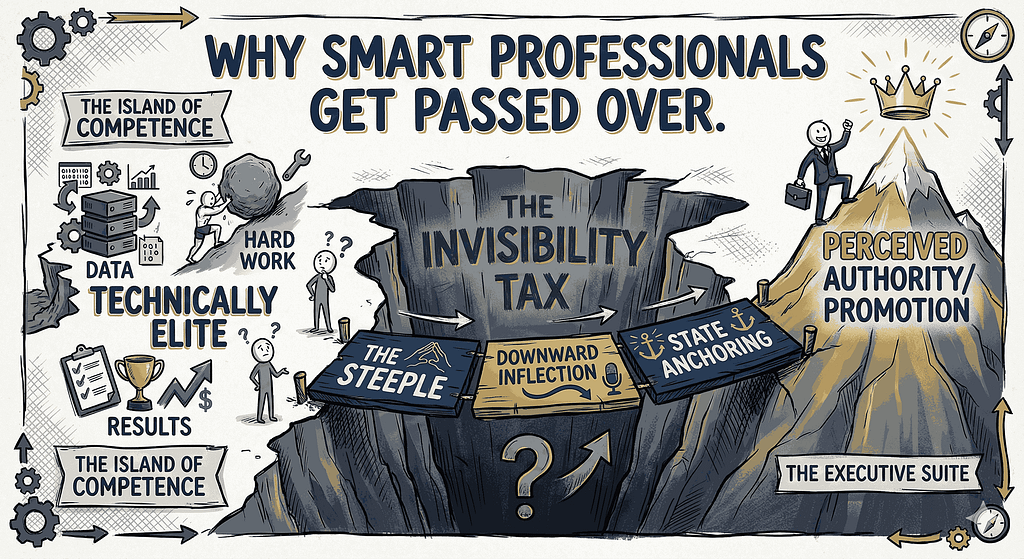
If you are short of time or would like the short visual version please click here to watch the YouTube Video.
Why do I keep getting interrupted? And What can I do about it?
1. The Body: Change your posture From “The Appeaser” to “The Leveler”
The Problem: Most mid-career professionals unconsciously use “The Appeaser” posture. You hunch, nod excessively while listening to show you are engaged, and tilt your head to the side. In HR terms, this signals you are subservient, not strategic. You look like you are asking for safety, not offering direction.
The Science: According to Behavioral science of Body Language, “Presence” is not a single gesture; it is a congruent cluster of signals. If you use confident words but your head is tilted (submission signal), the observer’s brain instinctively distrusts you.
To project authority, you must align three specific zones simultaneously: Hands, Head, and Eyes.
The Fix (In-Person): The Executive Triad You must execute these three micro-behaviors at the same time:
- The Hands (The Steeple): Touch your fingertips together like a church roof with palms separated. It is the universal signal of intellectual confidence. Crucially, if you break the steeple to gesture, keep your Palms Down (smoothing the table). Palms Up signals begging; Palms Down signals command.
- The Head (The Leveler): Stop tilting. Keep your chin parallel to the floor. Stop nodding. High-status individuals nod rarely. Your stillness makes your eventual “Yes” weigh more.
- The Eyes (The Power Gaze): When delivering a recommendation, do not look at the mouth of others. Look at the triangle between their eyes and the center of their forehead. This signals analysis, not socialization.
The Remote Adaptation: On Zoom, you are usually a “floating head.” If your hands are invisible and you are staring at your own screen, you lose 50% of your impact.
The Move: Push your chair back 12 inches. Frame yourself so your chest and lower ribs are visible.
- The Zoom Steeple: When making a key point, lift your hands into the frame and Steeple. Seeing hands creates a “3D effect” that makes you feel physically present.
- The Lens Gaze: To execute the “Power Gaze” remotely, look directly into the camera lens, not at the faces on the screen.
The Exact Script Box:
Don’t say (while leaning forward and nodding): “Um, sorry, can I just add one quick thing if that’s okay?”
Instead, say (while executing The Triad): [Action: Sit back. Form Steeple. Stop nodding. Look at lens/forehead.]
“[John], I have the data on our next steps. Let’s look at the three levers we need to pull.”
Why is my advice being ignored by senior management?
2. The Voice: Master “Command Tonality”
The Problem: “Uptalk.” This is where your pitch goes up at the end of a sentence. To a senior executive, you sound like you are asking for permission to be right.
The Science: High-status individuals use Downward Inflection. The vocal pitch drops at the end of the thought. This triggers a “Respect” response in the listener’s brain because it signals conviction.
The Fix (In-Person): Master “The Power of the Pause.” State your point with a downward inflection. Then, stop talking. Count to three. Do not fill the silence with “Right?” or “Does that make sense?”.
The Remote Adaptation: We often speed up on Zoom to avoid “dead air.”
- The Technique: You must become comfortable with Digital Silence.
- The Move: State your point, drop your pitch, and immediately mute yourself. This creates a “hard stop” that forces the other person to fill the silence with agreement.
The Exact Script Box
Don’t say: “I think we should move the deadline to Tuesday?” (Pitch rising).
Instead, say: “The data shows Tuesday is the hard deadline. I’ve updated the project map.” (Pitch dropping on “map”).
How do I stay confident in high-stakes meetings?
3. The Mind: The “State Anchor”
The Problem: Entering a high stakes meeting immediately after a stressful task. Your micro-expressions show tension. If you can’t influence your own neurology, you cannot influence a room.
The Science: In Neuro Science, we use Anchoring. This is a physical trigger you associate with a memory of total victory.
The Fix (In-Person): Before walking into the boardroom, perform a “Power Reset.” Stand tall and fire your anchor (e.g., squeezing your left thumb) to “load” your confidence state.
The Remote Adaptation: The Ritual: 2 minutes before the camera goes on, stand up. Sitting compresses your diaphragm and lowers your energy.
- The Entry: Squeeze your thumb. Only hit “Join Meeting” when you feel that vibration of confidence. On video, pixels flatten emotion; you need to be at 110% energy to look like 100% on screen.
The Bottom Line
Executive Presence is not a gift. It is a set of mechanical signals. If you don’t send the signals, you don’t get the seat.
Stop being the “Best Kept Secret” in your company. Use the Steeple, drop your inflection, and fire your Anchor. Hack the behavior, and the promotion will follow.
Ready to stop paying the Invisibility Tax? I help mid-career professionals navigate these behavioral mechanics and secure the promotions they’ve earned.
[Please reach out if you want the 30-Day Executive Presence Audit to help you figure out your current style so that you can make changes.]
Why Trust My Advice?
As a senior HR executive at global organizations and a behavioral coach, I’ve directed talent strategies for thousands of employees across technology, finance, CPG, and Manufacturing sectors. I’ve participated in Promotion and Performance Calibration sessions, observed how decisions are made, and guided hundreds of professionals to not just survive but thrive in challenging markets. My strategies aren’t theoretical—they’re battle-tested, creative, based on behavioral science, and designed to provide you with a competitive edge.
Click here for my LinkedIn Profile.
Whether securing a promotion or avoiding a layoff, I offer personalized coaching based on a combination of behavioral insights and real-world experience not available elsewhere.
Please feel free to reach out if you need specific help related to your situation which might require additional behavioral interventions.
For other insightful articles on Career Growth and Job Search, please read my blog.
For short videos of easy to apply Behavioral techniques in your Career and Workplace situations – Please subscribe to my YouTube Channel
If you want to learn how to build and apply behavioral skills like Self-confidence, mastering these steps, check out my behavioral coaching programs at www.changeforresults.com. We can work together to build a career that succeeds without burning you out.