
Reporting to a Younger Boss? Stop “Parenting” Them if You Want to Keep Your Job
Reporting to a younger boss? this is not uncommon in the corporate world. Especially with Baby Boomers approaching the retirement age and new generation coming into the workforce, we are finding more such situations. In my experience, this is bringing in its own set of challenges, primarily amongst them being “Ego clashes” and Frustration at not being able to understand each other.
A negative consequence of this can sometimes be the corporate world covertly “Managing out” older employees for “Cultural Friction.” This is unfortunate – a veteran professional—brilliant, loyal, and experienced having to leave because they couldn’t navigate the ego dynamics of reporting to a “High Potential” manager twenty years their junior.
There is a behavioral explanation for why this happens. Once you understand it, it is easy to fix. It starts with an older employee feeling deep down that they are being managed by their child, and the younger boss feeling like they are managing their parent. Left unaddressed, both parties are in a danger zone. To survive, you must stop being the “brake” and start being the “steering wheel.”
The “Reverse Mentorship” Myth: Why Common Advice Fails
Most career blogs tell you to “offer to mentor” your younger boss. Let me tell you – In the real world, this is often career suicide.
When you offer to “mentor” someone who has authority over your paycheck, you are subtly claiming superiority. It signals that you believe they are unqualified. This triggers deep seated insecurities in a younger manager, leading to micromanagement as they try to assert their dominance.
The Insider Truth: You don’t need to be their teacher. You need to be their most sophisticated tool for success.
Let me share with you two behavioral strategies you can implement immediately for a better “Working Relationship” if you are reporting to a younger boss.
If you are short of time or would like the short visual version please click here to watch the YouTube Video.
1. The Relationship Fix: Transactional Analysis
Stop the “Parent-Child” Loop
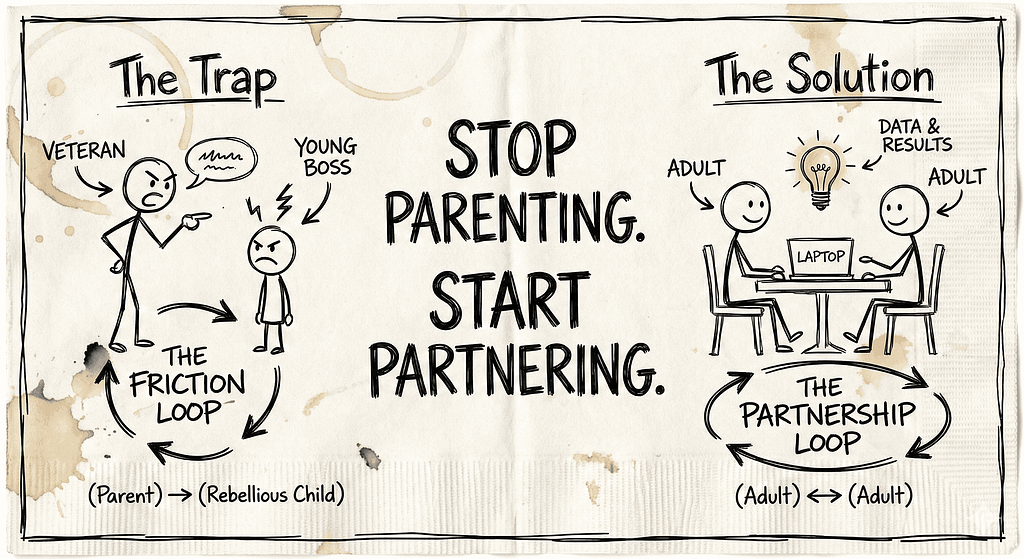
The Problem: Most older employees unconsciously adopt a “Critical Parent” tone. When you warn a younger boss about “how things used to be” or correct their “hasty” decisions, you trigger their defensive “Rebellious Child” state. They stop hearing your wisdom and start focusing on your “attitude.”
The Science: This is based on Transactional Analysis (TA). Human communication moves between three “Ego States”: Parent, Adult, and Child.
- Parent: Evaluative, judgmental, or care-taking.
- Child: Emotional, reactive, or seeking approval.
- Adult: Logical, data-driven, and objective.
Because of the age gap, both parties often fall into a Parent-Child trap. To break it, you must remain strictly in the Adult state. The Adult deals only in data and Facts, not history or judgment.
Your goal should be “Partnering” not “Parenting”
The Exact Script
Scenario: Your boss proposes a “hasty” idea that you know will fail because of past experience.
- Don’t Say (Parent): “That won’t work. You don’t understand the legacy systems. We tried that in 2015 and it was a mess.”
- Instead, Say (Adult): “That is a bold move. Looking at the 2015 data, the pilot showed a 40% drop in retention when we implemented it. If we solve for the issues we faced then in this new version, the speed of delivery will increase. What is your plan for mitigating those past issues?”
2. The Speed Fix: Pacing and Leading
Don’t Be a Brake; Be a Steering Wheel
The Problem: Younger managers are often driven by Speed. They want to produce quick results to validate their promotion. Older employees are often driven by Stability and therefore they insist on thinking through decisions as well as accuracy. Problem is that when they try to slow their younger bosses down to “do it right,” they become the enemy of their ambition.
The Science: In Behavioral Science, you cannot lead someone to an outcome solution you are offering if you do not first agree with them. If you immediately resist an idea, you break “rapport.” Once rapport is broken, your expertise is ignored.
The Technique: You must match their need for speed, before you can introduce your wisdom.
The Exact Script Box
Scenario: Boss sets an unrealistic deadline to impress the executive team.
- Don’t Say (The Brake): “We can’t get that done by Friday. We need at least two weeks to do the quality checks properly. It’s not realistic.”
- Instead, Say (The Steering Wheel): > 1. (Acknowledge): “I get why we need this by Friday. Hitting that date would be a huge win for the department’s visibility.” 2. (recommend): “To get that done, we will have to bypass the standard QA process. I can make Friday, but it might result in some bugs. Can you please sign off on that risk, or we alternatively we can launch Tuesday with zero bugs. Which would you prefer?”
3. Case Study: The VP Who Lost His Seat
I once worked with a VP of Finance who had 30 years of experience. He reported to a 36-year-old CFO. During every leadership meeting, the VP would lean back, cross his arms, and say, “Now, let me tell you how we handled the 2008 crash…”
He thought he was being helpful. The CFO thought he was being condescending.
Within six months, the VP was “restructured” out of the organization. He wasn’t fired for his financial modeling; he was fired because the CFO felt he couldn’t lead a team that was constantly being “schooled” by a subordinate. The lesson? Your knowledge is only valuable if it is delivered as a peer, not a professor.
How to Assess Your situation
If you want to find out where you stand with a younger boss, look for these three “Red Flags” in your behavior:
- The “History” Crutch: Do you start sentences with “In my day” or “Back at my previous Company”?
- The Eye Roll: Do you show visible frustration when new technologies or agile methodologies are introduced?
- The Safety Net: Do you wait for them to fail just so you can say “I told you”?
If you do any of these, you will most likely be labeled by your bosses as a “Blocker.”
Your experience should be your greatest asset, not the reason for you to be sidelined. If you believe you are undergoing a similar situation in your career and want to “Survive and Thrive”, Click here to discuss on a confidential 1-on-1 Executive Strategy Session.
Why Trust My Advice?
As a senior HR executive at global organizations and a behavioral coach, I’ve directed talent strategies for thousands of employees across technology, finance, CPG, and Manufacturing sectors. I’ve participated in Promotion and Performance Calibration sessions, observed how decisions are made, and guided hundreds of professionals to not just survive but thrive in challenging markets. My strategies aren’t theoretical—they’re battle-tested, creative, based on behavioral science, and designed to provide you with a competitive edge.
Click here for my LinkedIn Profile.
Whether securing a promotion or avoiding a layoff, I offer personalized coaching based on a combination of behavioral insights and real-world experience not available elsewhere.
For other insightful articles on Career Growth and Job Search, please read my blog.
For short videos of easy to apply Behavioral techniques in your Career and Workplace situations – Please subscribe to my YouTube Channel
If you want to learn how to build and apply behavioral skills like Self-confidence, mastering these steps, check out my behavioral coaching programs at www.changeforresults.com.
Let us build your dream career together.
#officepolitics #managing up #howtogetpromoted